Overview
Markup measures how much is added to cost to arrive at a selling price, usually expressed as a percentage of cost.
Objective
Calculate markup amount, markup percentage or a selling price from cost.
What You Need
- Cost price
- Selling price or desired markup rate
- Calculator
Before You Start
Identify whether you need the dollar markup, markup percentage or selling price.
How to Calculate
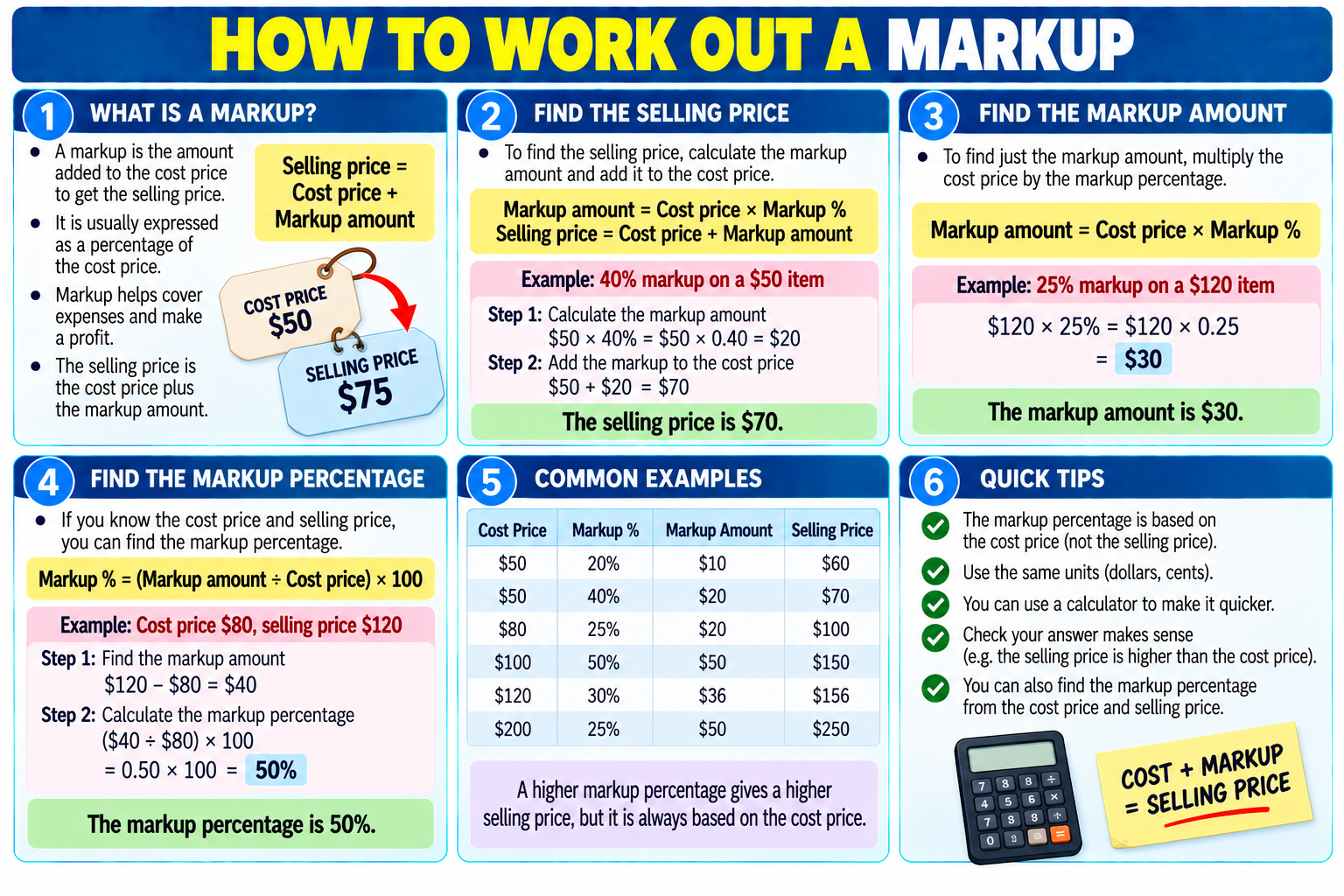
- Markup amount = selling price − cost.
- Markup % = markup amount ÷ cost × 100.
- Selling price from markup rate = cost × (1 + markup rate as a decimal).
Worked Example
An item costs $80 and sells for $100. Markup is $20. Markup percentage = 20 ÷ 80 × 100 = 25%.
Useful Tips
- Markup uses cost as the denominator.
- Convert a percentage markup to a decimal before using the multiplier.
- Do not substitute desired profit margin for markup without converting it.
Common Mistakes
- Dividing markup by selling price, which gives margin instead.
- Adding 25 rather than 25% of cost.
- Assuming 25% markup means 25% profit margin.
Important Notes
Retail pricing may also need to account for GST/sales tax, discounts, overheads and target margins.
FAQ
What is the difference between markup and margin?
Markup is profit relative to cost; margin is profit relative to selling price.
What multiplier gives a 30% markup?
1.30, before any separate taxes or adjustments.