Overview
A rebus represents a word, phrase or saying through the position, size, repetition or appearance of words, letters, numbers and pictures.
Objective
Interpret the visual arrangement to identify the intended word or phrase.
What You Need
- A rebus puzzle
- Observation and wordplay
- Optional answer sheet
Setup
Look at every feature, not just the literal words. Position, direction, repetition, size, colour and whether something is inside, outside, over or under something else may all be clues.
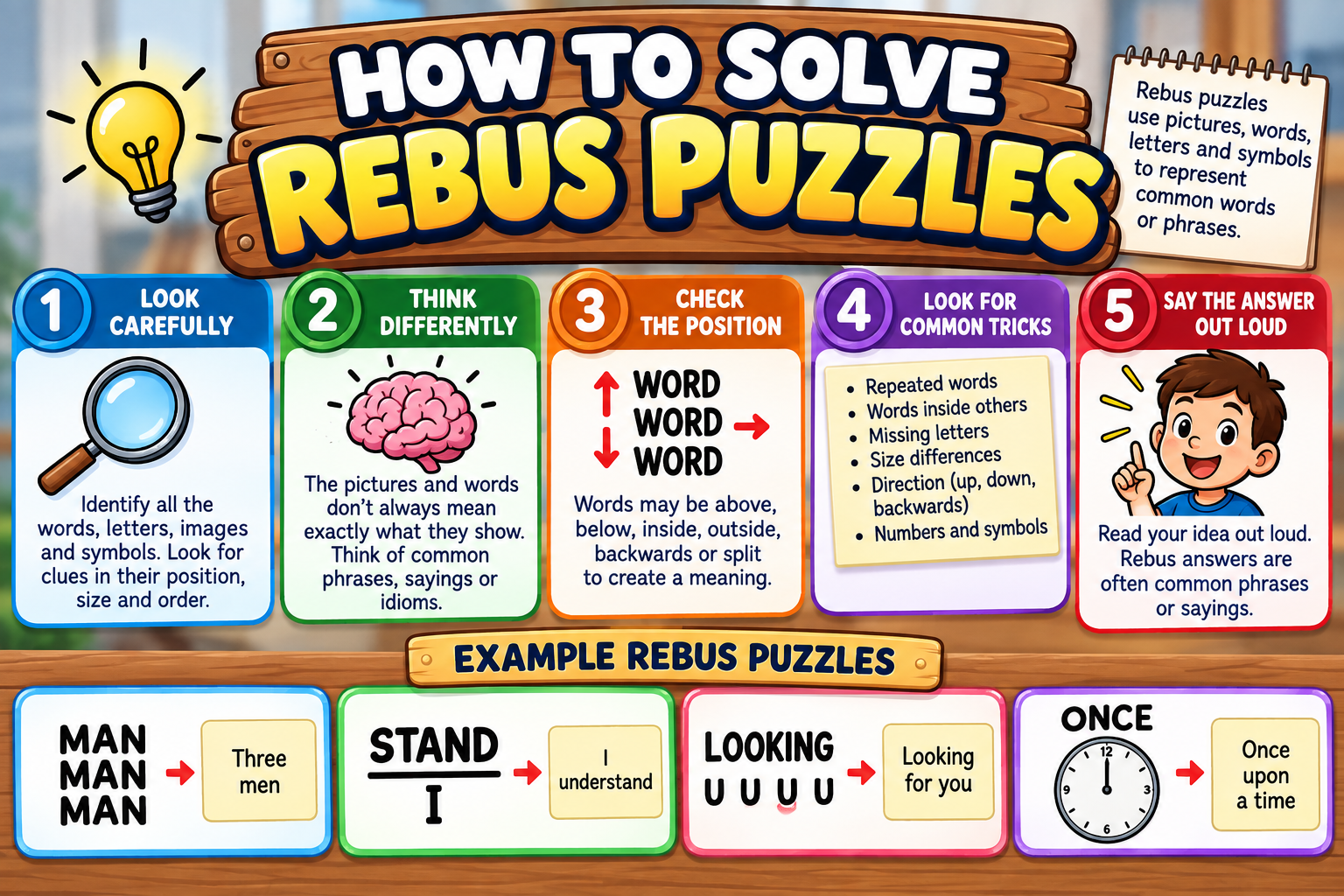
How to Solve
- Read the visible words or symbols literally.
- Describe their arrangement out loud.
- Notice unusual spacing, repetition, direction or size.
- Turn that description into familiar phrases or sayings.
- Check that every important visual feature is explained by your answer.
Worked Example
If the word CYCLE appears three times in a row, you might describe it as “three cycles.” A rebus answer should account for both the word itself and the way it is presented.
Strategy Tips
- Say what you see before trying to guess the phrase.
- Common relationship words include over, under, inside, outside, broken, backwards and repeated.
- Do not ignore typography; tiny or oversized text may be deliberate.
Common Mistakes
- Focusing only on the word meaning.
- Choosing a phrase that explains only part of the picture.
- Overcomplicating a simple spatial clue.
Variations & House Rules
Rebuses may use pictures, emojis, numbers, letter sounds, colours or combinations of several devices.
FAQ
Is there always one answer?
Well-designed rebuses usually have one intended answer, although alternative interpretations can occur.
Do colours matter?
Sometimes. Treat any unusual visual choice as potentially meaningful.