Overview
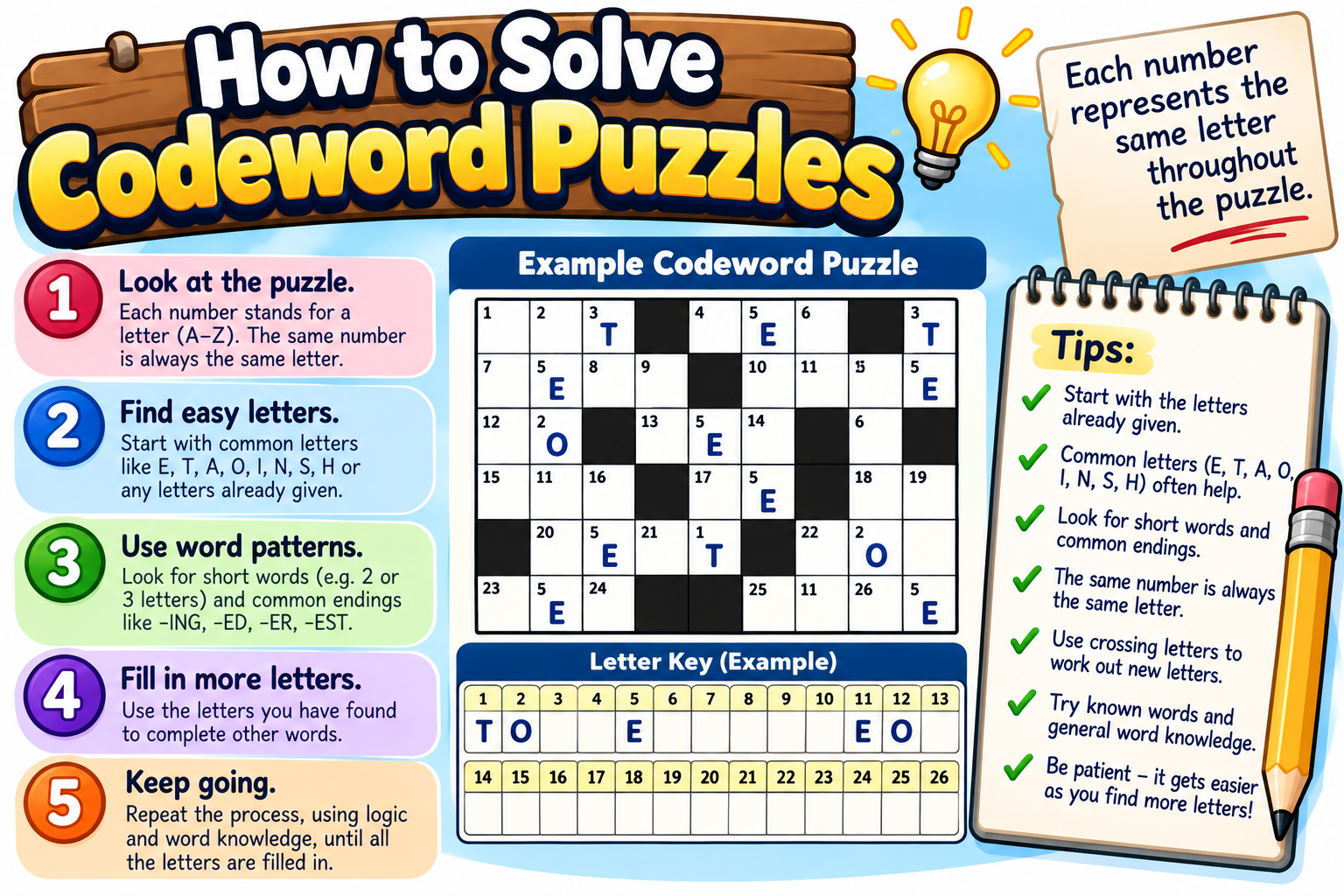
A codeword puzzle looks like a crossword grid but replaces each letter with a number. The same number represents the same letter everywhere in the puzzle.
Objective
Discover the number-to-letter mapping and use it to complete every word in the grid.
What You Need
- A codeword grid
- Alphabet or code table
- Pencil or keyboard
Setup
Enter any starter letters supplied by the puzzle. Then look for repeated number patterns and common short-word structures.
How to Solve
- Record each known number-to-letter mapping.
- Apply that letter everywhere the same number appears.
- Look for word patterns created by the known letters.
- Test likely words without assigning contradictory letters.
- Use newly confirmed letters throughout the grid.
- Continue until the alphabet mapping and grid are complete.
Worked Example
If code 7 is given as E, replace every 7 in the grid with E. A pattern such as 12-7-7 may then resemble a common three-letter word with double E, narrowing the first letter.
Strategy Tips
- Repeated numbers create repeated letters, which is a powerful pattern clue.
- Short words can unlock many code values quickly.
- Keep a visible alphabet table so you do not assign the same letter inconsistently.
Common Mistakes
- Changing a code value in only one square.
- Assigning one number to two different letters.
- Forcing a word that fits locally but contradicts other appearances of the same codes.
Variations & House Rules
Some codewords provide several starter letters, while harder versions provide none. Symbol codewords use icons instead of numbers.
FAQ
Can two numbers represent the same letter?
In a standard codeword, no; each code maps consistently to one letter.
Is it a crossword?
It uses a crossword-like grid, but there are normally no conventional clues—the code patterns are the clues.