Overview
Texas Hold’em is a community-card poker card game. This guide uses a straightforward common ruleset and notes where versions often differ.
Objective
Win pots with the best five-card poker hand or by getting all opponents to fold.
What You Need
- 52-card deck, chips, dealer button
- 2–10 player(s), as appropriate
- A clear table or playing area
Setup
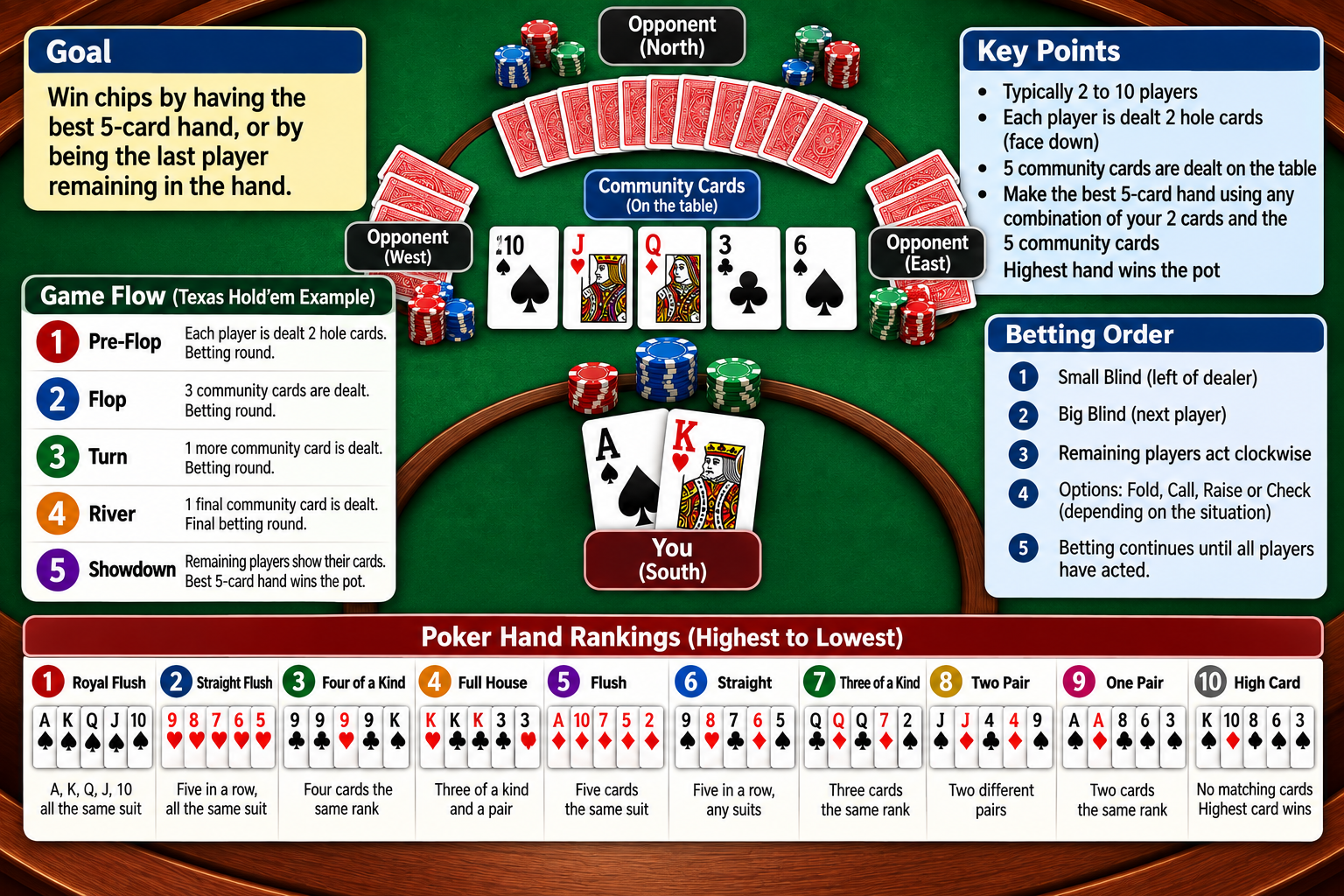
Choose blinds and starting chips. Place the dealer button, post small and big blinds, then deal two private hole cards to each player.
How to Play
- Complete the pre-flop betting round.
- Deal three community cards face up (the flop), then bet.
- Deal one community card (the turn), then bet.
- Deal the fifth community card (the river), then bet.
- At showdown, each remaining player makes the best five-card hand from any combination of their two hole cards and five community cards.
Scoring / Winning
Hold’em is normally tracked in chips, not cumulative points. A pot is won uncontested after folds or by the best five-card hand at showdown.
Worked Example
With A♠ K♥ and a board of Q♦ J♥ 10♠ 3♣ 6♠, your best five-card hand is an Ace-high straight.
Strategy Tips
- Learn position, starting-hand selection and pot odds gradually.
- Protect cards and act only when it is your turn.
- Set friendly chip values or stakes before the game begins.
Common Mistakes
- Thinking both hole cards must be used; Hold’em allows zero, one or two.
- Making a seven-card hand instead of selecting the best five.
- Acting out of turn.
Variations & House Rules
No-Limit, Pot-Limit and Fixed-Limit Hold’em use different betting limits; tournament and cash formats also differ.
FAQ
Must I use both hole cards?
No. Your best five-card hand may use zero, one or both hole cards.
How many community cards are there?
Five: three on the flop, one turn and one river.
Score Card
Open the CS17 fillable Texas Hold’em Game Sheet to enter names and results on screen, then print it or save it as a PDF.