Overview
Spider Solitaire is a patience card game. This guide uses a straightforward common ruleset and notes where versions often differ.
Objective
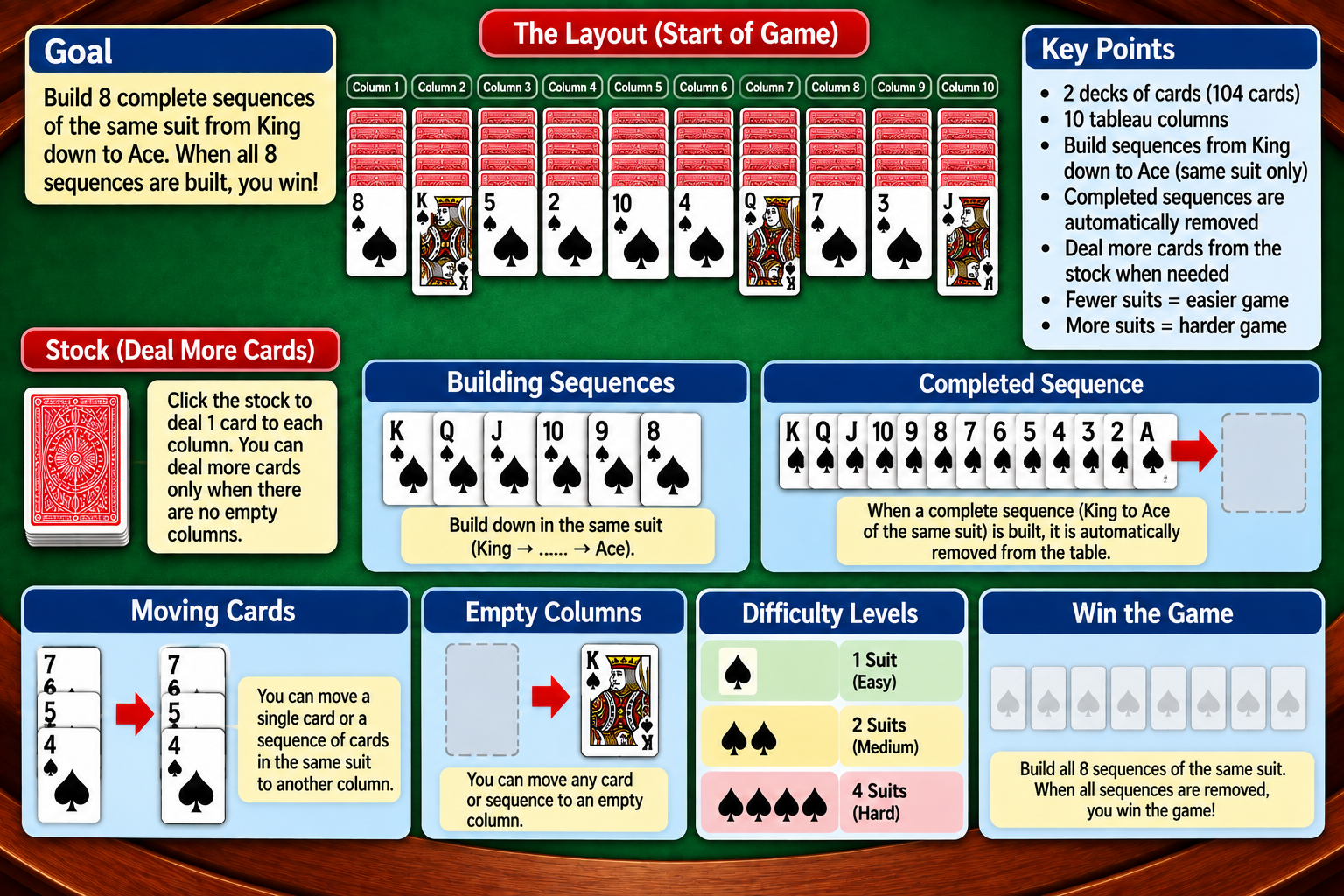
Clear the tableau by completing eight same-suit sequences from King down to Ace.
What You Need
- 2 standard decks (104 cards)
- 1 player(s), as appropriate
- A clear table or playing area
Setup
Deal 54 cards into 10 tableau columns, with only each column’s top card face up. Keep the remaining 50 cards as a stock for five later deals of 10 cards.
How to Play
- Build tableau cards downward by rank.
- You may place a card on the next higher rank regardless of suit, but only properly ordered same-suit sequences can normally move together as a unit.
- Turn over a newly exposed face-down card immediately.
- Use empty columns to reorganise cards.
- When no empty columns remain, deal one stock card face up onto each tableau column.
- A complete same-suit King-to-Ace sequence is removed automatically; remove all eight to win.
Scoring / Winning
Physical Spider Solitaire is normally treated as a win/loss puzzle, so no score card is required. Computer versions may use move and time scoring.
Worked Example
A 7 may be placed on an 8. Building 7♠–6♠–5♠ keeps a movable same-suit sequence; mixed-suit descending cards may be harder to move together.
Strategy Tips
- Prioritise exposing face-down cards.
- Create empty columns and use them carefully.
- Build same-suit sequences whenever practical before dealing another row.
Common Mistakes
- Dealing from the stock while a tableau column is empty.
- Assuming any mixed-suit descending sequence can move as one unit.
- Filling an empty column without a plan to uncover more cards.
Variations & House Rules
One-suit Spider is easiest, two-suit is intermediate and four-suit is the standard difficult version.
FAQ
How many cards are used?
104 cards, equivalent to two standard decks.
When can I deal another row?
In standard Spider, only when no tableau column is empty.