Overview
Rummy is a sets & runs card game. This guide uses a straightforward common ruleset and notes where versions often differ.
Objective
Form sets and runs, reduce cards left in hand and be first to go out.
What You Need
- Standard 52-card deck
- 2–6 player(s), as appropriate
- A clear table or playing area
Setup
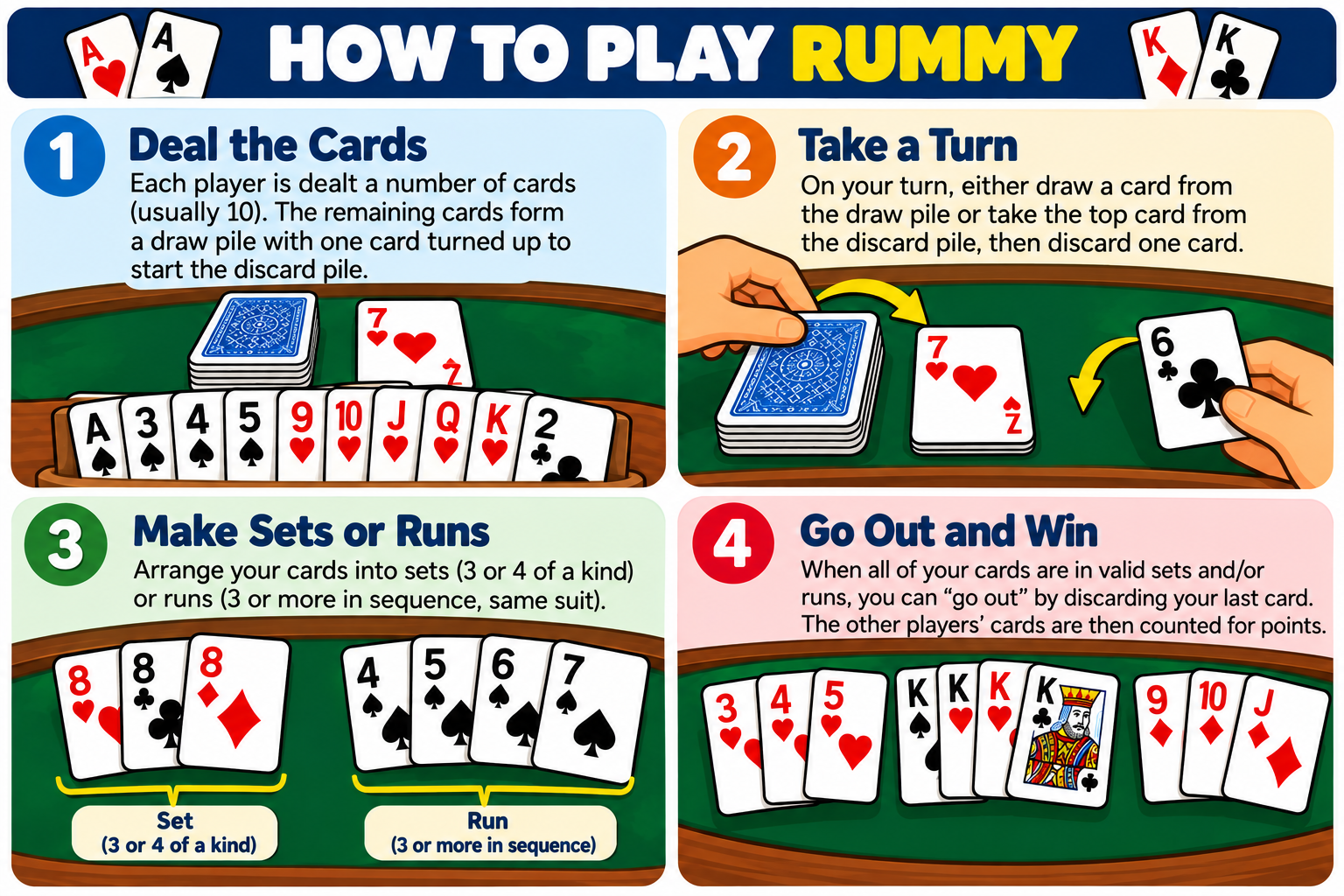
Deal the agreed number of cards to each player. Place the remaining deck face down as the stock and turn one card face up to start the discard pile.
How to Play
- Draw from the stock or discard pile according to your version.
- Form sets of equal ranks and runs of consecutive cards in one suit.
- Lay down melds when permitted and add cards to existing melds under the agreed rules.
- Discard one card to end your turn.
- The hand ends when a player legally disposes of all cards.
Scoring / Winning
Rummy scoring varies. A common method awards the winner the value of cards left in opponents’ hands; another records each player’s remaining-card penalty. Agree before play.
Worked Example
7♣ 8♣ 9♣ is a run; three Queens of different suits form a set. A card cannot be used in two combinations at once.
Strategy Tips
- Keep cards with multiple melding possibilities.
- Watch which cards opponents pick up.
- Discard isolated high-value cards when they become unlikely to meld.
Common Mistakes
- Mixing suits within a run.
- Using duplicate suits/ranks incorrectly in a set for the chosen rules.
- Forgetting the final discard requirement where it applies.
Variations & House Rules
Gin Rummy, 500 Rummy, Indian Rummy and many house versions change dealing, melding and scoring.
FAQ
How many cards make a meld?
Usually at least three, though the exact version controls.
Can I take from the discard pile?
Usually yes, but the method and restrictions depend on the Rummy version.
Score Card
Open the CS17 fillable Rummy Game Sheet to enter names and results on screen, then print it or save it as a PDF.