Overview
Poker is a betting & hand ranking card game. This guide uses a straightforward common ruleset and notes where versions often differ.
Objective
Win the pot by making the best qualifying hand or by causing all other players to fold.
What You Need
- 52-card deck, chips or score markers
- 2–10 player(s), as appropriate
- A clear table or playing area
Setup
Choose a poker variant and betting structure. For Texas Hold’em, give each player two private hole cards and use five community cards dealt in stages.
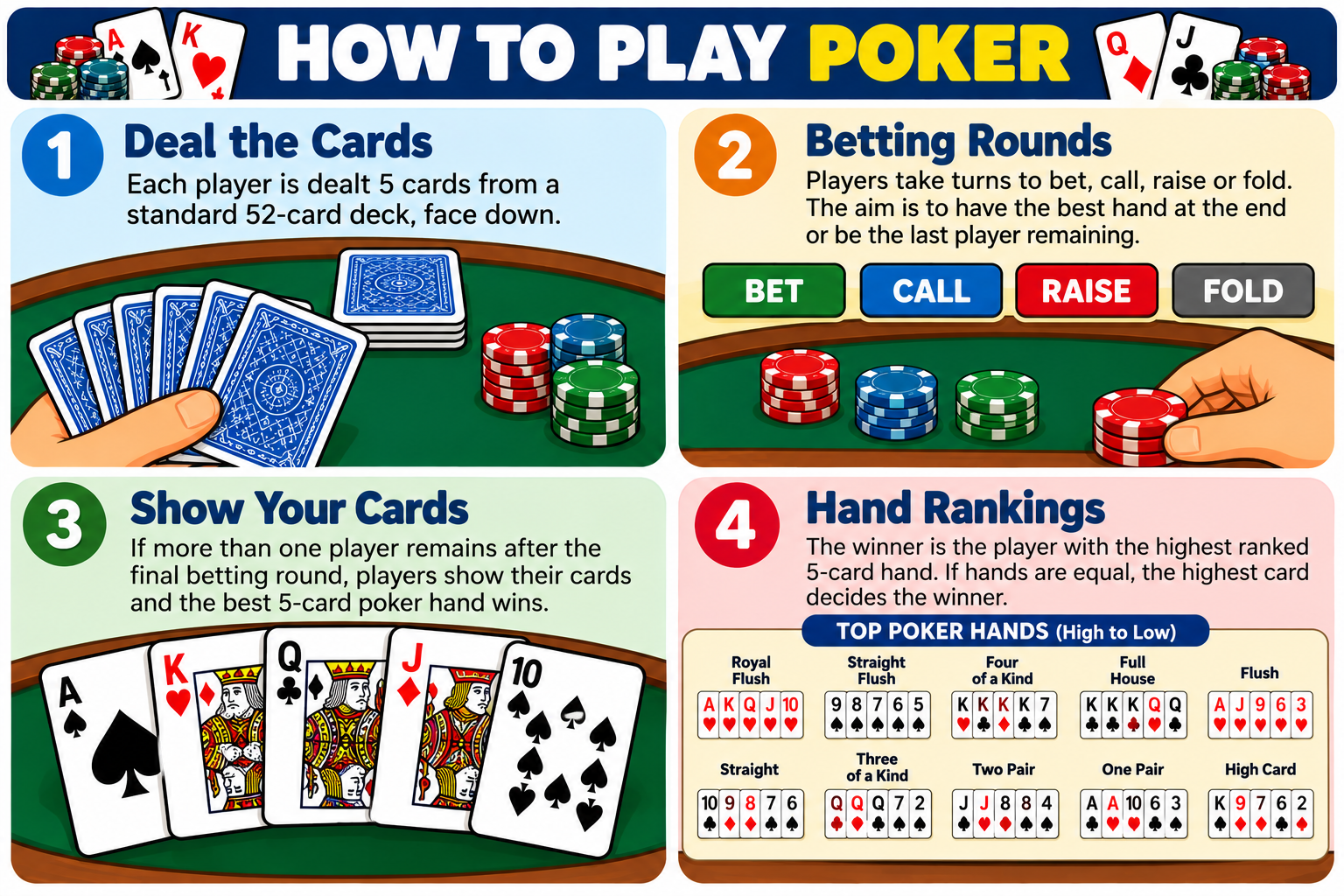
How to Play
- Post any required blinds or antes.
- Deal the starting cards and complete the first betting round.
- In Texas Hold’em, deal the flop (3 community cards), then bet.
- Deal the turn and river one at a time, with betting after each.
- At showdown, remaining players make their best five-card hand and compare rankings.
Scoring / Winning
Poker normally uses chips rather than a cumulative score sheet. The pot goes to the last player remaining after folds or the best hand at showdown.
Worked Example
With A♠ K♥ in your hand and Q♦ J♥ 10♠ among the community cards, you can form an Ace-high straight using five cards.
Strategy Tips
- Learn the hand rankings before worrying about advanced betting.
- Consider position and the range of hands opponents can hold.
- Set betting limits appropriate to the group before play.
Common Mistakes
- Using six or seven cards as the final poker hand; the evaluated hand is five cards.
- Acting out of turn.
- Confusing a flush with a straight.
Variations & House Rules
Texas Hold’em, Omaha, Five-Card Draw and Stud use different dealing and hand-building rules.
FAQ
Does every poker game use community cards?
No. Community cards are used in games such as Hold’em and Omaha, but not all poker variants.
How many cards make the final hand?
Five.
Score Card
Open the CS17 fillable Poker Game Sheet to enter names and results on screen, then print it or save it as a PDF.