Overview
Learn the classic matching game where players remember card positions and collect pairs.
Objective
Collect more matching pairs than the other players.
What You Need
A set of matching card pairs
Setup
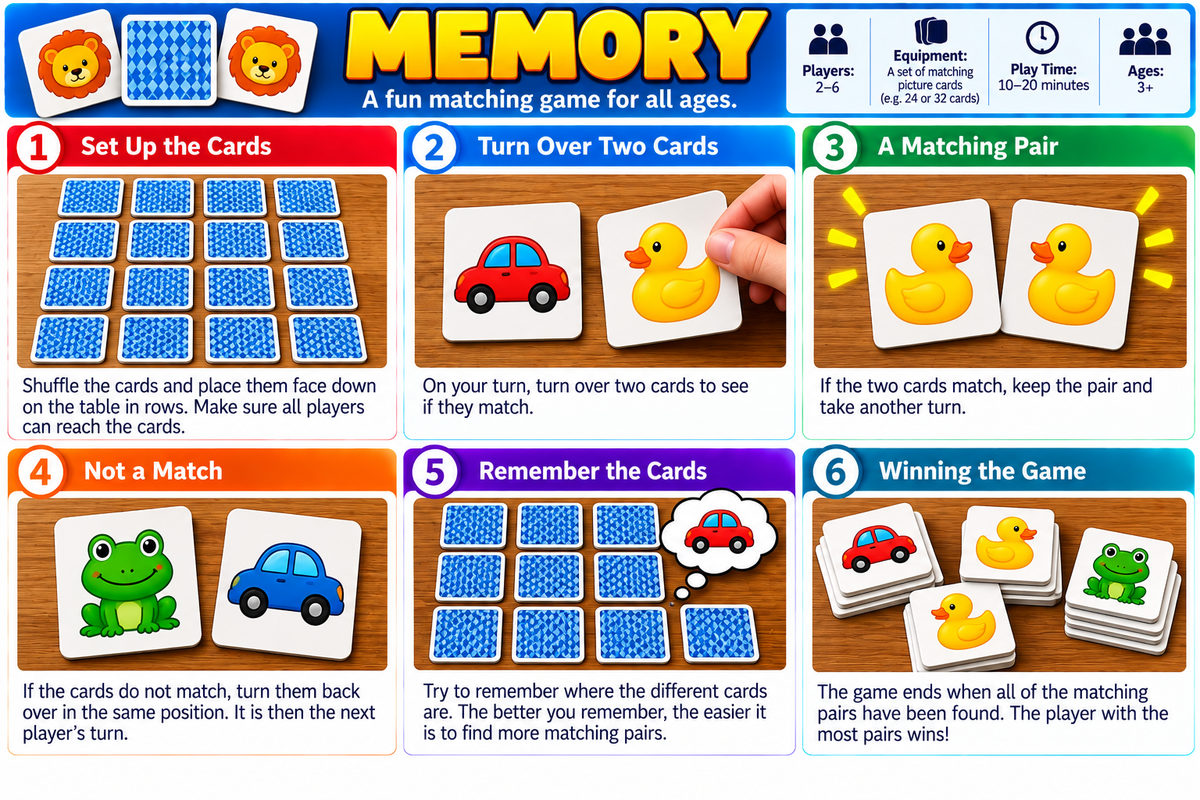
Shuffle all cards and place them face down in neat rows and columns so every card can be reached.
How to Play
On your turn, turn over two cards so everyone can see them. If they match, keep the pair. If they do not match, turn both cards face down again after everyone has seen them.
Key Rules
A player who finds a matching pair commonly takes another turn. All players should have a fair chance to see revealed cards before they are turned back over.
Useful Terms
- Pair: Two cards that match under the agreed rules.
- Reveal: Turn a face-down card face up for everyone to see.
- Layout: The fixed rows and columns of face-down cards.
Rules in More Detail
Keep every card in the same position throughout the game. When two revealed cards do not match, give everyone enough time to see them before turning them face down again. That shared information is what makes Memory a game of observation rather than luck alone.
Winning the Game
When all pairs have been collected, count them. The player with the most pairs wins.
Worked Example
You reveal an apple card and then another apple card. Keep both cards as one pair and, under common rules, take another turn.
Strategy Tips
- Watch every card turned over, not only your own.
- Remember positions relative to corners and edges.
- When you know one card of a pair, wait until its partner is revealed.
- Keep the grid tidy so remembered positions do not shift.
Beginner Notes
Use landmarks: remember a card as 'second row, near the right edge' rather than trying to memorise the entire board as one picture.
Common Mistakes
- Moving face-down cards after play begins.
- Turning over more than two cards on a normal turn.
- Turning unmatched cards back too quickly for others to see.
Variations & House Rules
For younger players, use fewer pairs. For a harder game, use more cards or sets where images are similar rather than identical.
Frequently Asked Questions
Do I play again after finding a pair?
Commonly yes.
Can one person play alone?
Yes. Try to clear the board in as few turns as possible.
Can ordinary playing cards be used?
Yes, if you decide what counts as a matching pair.
Score Card
Open the CS17 fillable Memory Game Sheet to enter player names and game results on screen, then print it or save it as a PDF.