Overview
A beginner-friendly guide to Chess setup, piece movement, check, checkmate and the key special rules.
Objective
Checkmate the opponent’s king: attack it so there is no legal way to escape.
What You Need
Chessboard and 32 chess pieces
Setup
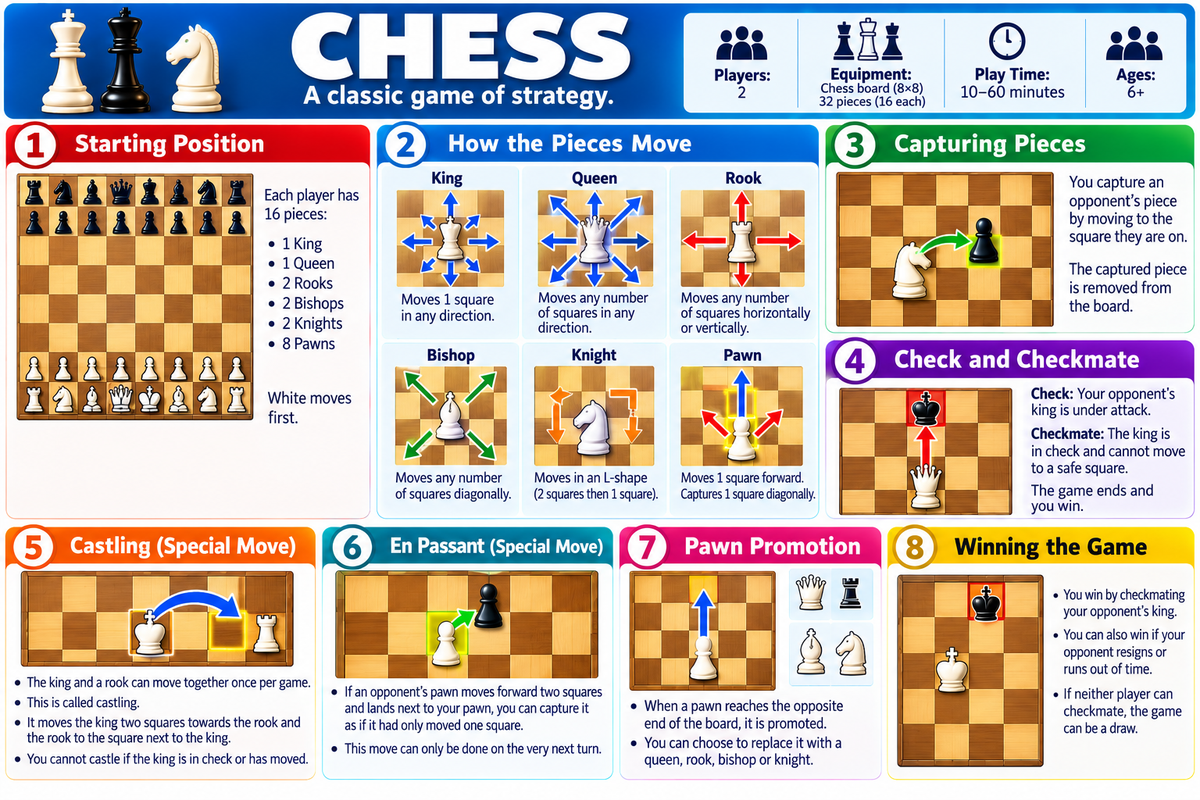
Place the board with a light square at each player’s lower-right corner. The back row is rook, knight, bishop, queen, king, bishop, knight, rook, with the queen on her own colour. Place eight pawns in the row in front.
How to Play
White moves first, then players alternate. Kings move one square in any direction; queens move any distance along ranks, files or diagonals; rooks move along ranks or files; bishops move diagonally; knights move in an L-shape; pawns usually move forward one square and capture diagonally.
Key Rules
A king may never move into check. Castling moves the king and rook together under specific conditions. Pawns reaching the farthest rank are promoted, usually to a queen. En passant is a special pawn capture that can occur immediately after an opposing pawn advances two squares past a capture square.
Useful Terms
- Check: The king is under attack and must be made safe.
- Checkmate: The king is in check and no legal response exists.
- Stalemate: The player to move has no legal move but is not in check; the game is drawn.
- Castling: A special king-and-rook move.
- Promotion: Replacing a pawn that reaches the last rank with a queen, rook, bishop or knight.
Rules in More Detail
A legal move may never leave your own king in check. When checked, you must remove the threat by moving the king, capturing the checking piece, or blocking the attack when blocking is possible. Castling is only legal if the king and chosen rook have not moved, the squares between them are empty, the king is not currently in check, and the king does not cross or finish on an attacked square.
Winning the Game
Checkmate wins the game. A game may also end in a draw, including stalemate, agreement, repetition or certain positions where checkmate cannot be achieved.
Worked Example
If a rook attacks the opposing king along an open rank, the king is in check. The opponent must respond by moving the king, capturing the attacking piece, or blocking the attack if possible.
Strategy Tips
- Develop knights and bishops early.
- Protect your king, usually by castling.
- Before every move, check what your opponent is attacking.
- Avoid moving the same piece repeatedly in the opening without a reason.
Beginner Notes
For beginners, focus on three opening goals rather than memorising long openings: control the centre, develop knights and bishops, and make the king safe. Before every move ask: Is my king safe? What did my opponent’s last move attack? Is any piece undefended?
Common Mistakes
- Leaving your own king in check.
- Forgetting that knights can jump over pieces.
- Moving a pawn backward.
- Castling through check or while the king is already in check.
Variations & House Rules
Common casual variations include different time controls and Chess960. Standard chess rules are best for learning the game.
Frequently Asked Questions
Who moves first?
White always makes the first move.
Can the king be captured?
No. The game ends at checkmate before the king is captured.
What can a pawn promote to?
A queen, rook, bishop or knight of the same colour.
Score Card
Open the CS17 fillable Chess Game Sheet to enter player names and game results on screen, then print it or save it as a PDF.