Overview
A simple budget compares expected income with planned expenses so you can see what is available for saving, spending or debt repayment.
Objective
Create a clear plan for money coming in and going out over a chosen period.
What You Need
- Income figures
- Regular bills and expenses
- Estimate of variable spending
- Paper, spreadsheet or budgeting tool
Before You Start
Choose a period such as weekly, fortnightly or monthly and convert all income and expenses to that same period.
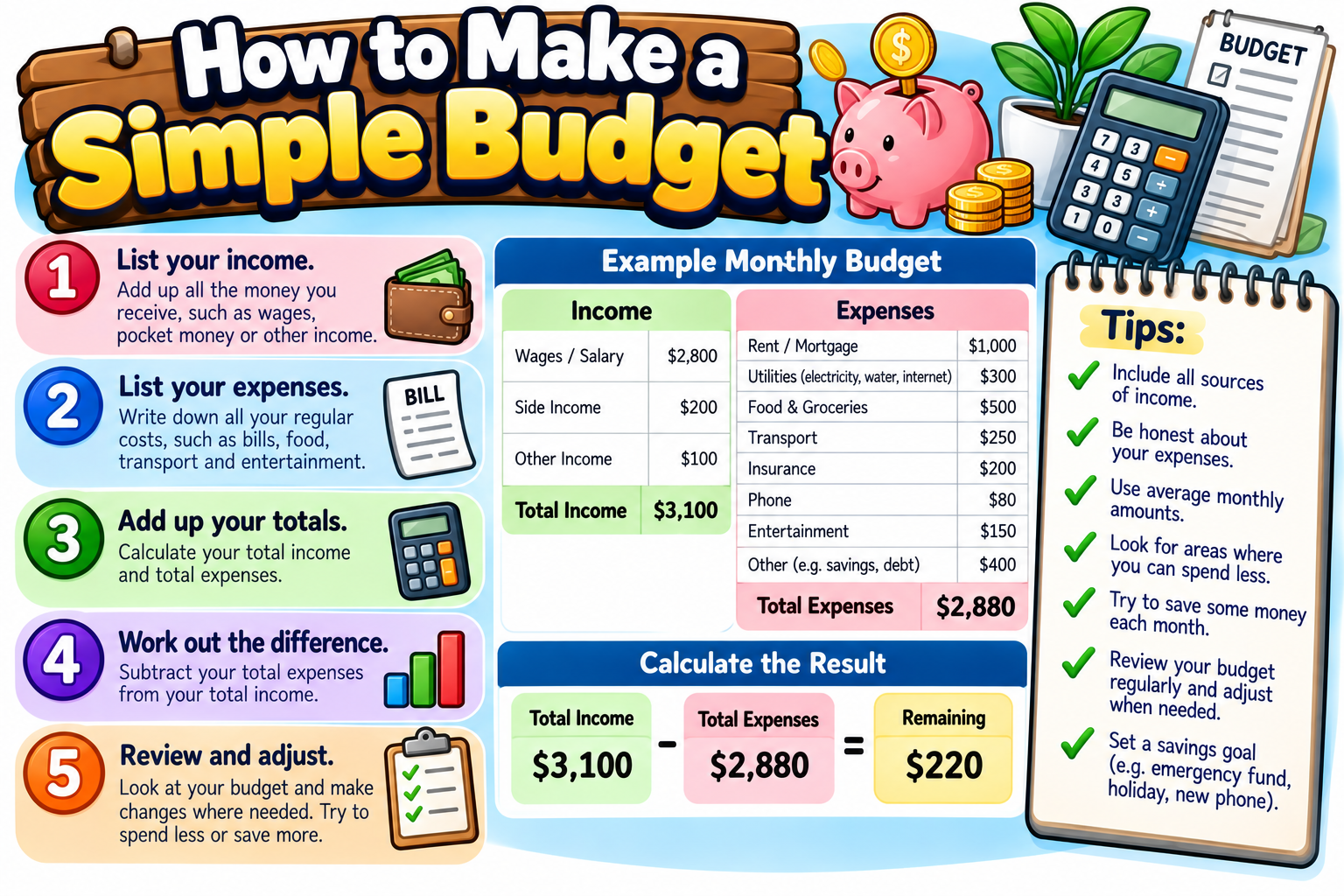
How to Make It
- List total income.
- List fixed expenses such as housing and regular bills.
- Estimate variable essentials such as groceries and transport.
- Add discretionary spending and planned savings.
- Subtract total outgoings from income.
- Adjust categories if the result does not match your goals.
Worked Example
Monthly income is $4,000. Expenses and planned savings total $3,650. The remaining buffer is $350.
Useful Tips
- Use actual recent bills or statements where possible.
- Include irregular expenses by setting aside a smaller amount each period.
- Leave a buffer for unexpected costs.
- Review the budget regularly rather than treating it as permanent.
Common Mistakes
- Mixing weekly and monthly figures.
- Forgetting annual or irregular bills.
- Making variable-spending estimates unrealistically low.
- Treating a budget as a record only rather than a forward plan.
Important Notes
Budgets can use category limits, zero-based budgeting, percentage-based methods or separate sinking funds for irregular costs.
FAQ
What if expenses are higher than income?
Review categories, prioritise essentials and identify expenses that can be reduced or income that can be increased.
Should savings be in the budget?
Yes, if saving is one of your planned uses of income.