Overview
Convert between seconds, minutes, hours, days, weeks and years.
Objective
Use the correct measurements, units and method to produce an accurate, clearly labelled result.
What You Need
- A time value
- Starting and target units
- Basic multiplication or division
Before You Start
Write down the value or dimensions you have, including their units. Decide exactly what unit or result you need before calculating. Keeping the units visible makes errors much easier to spot.
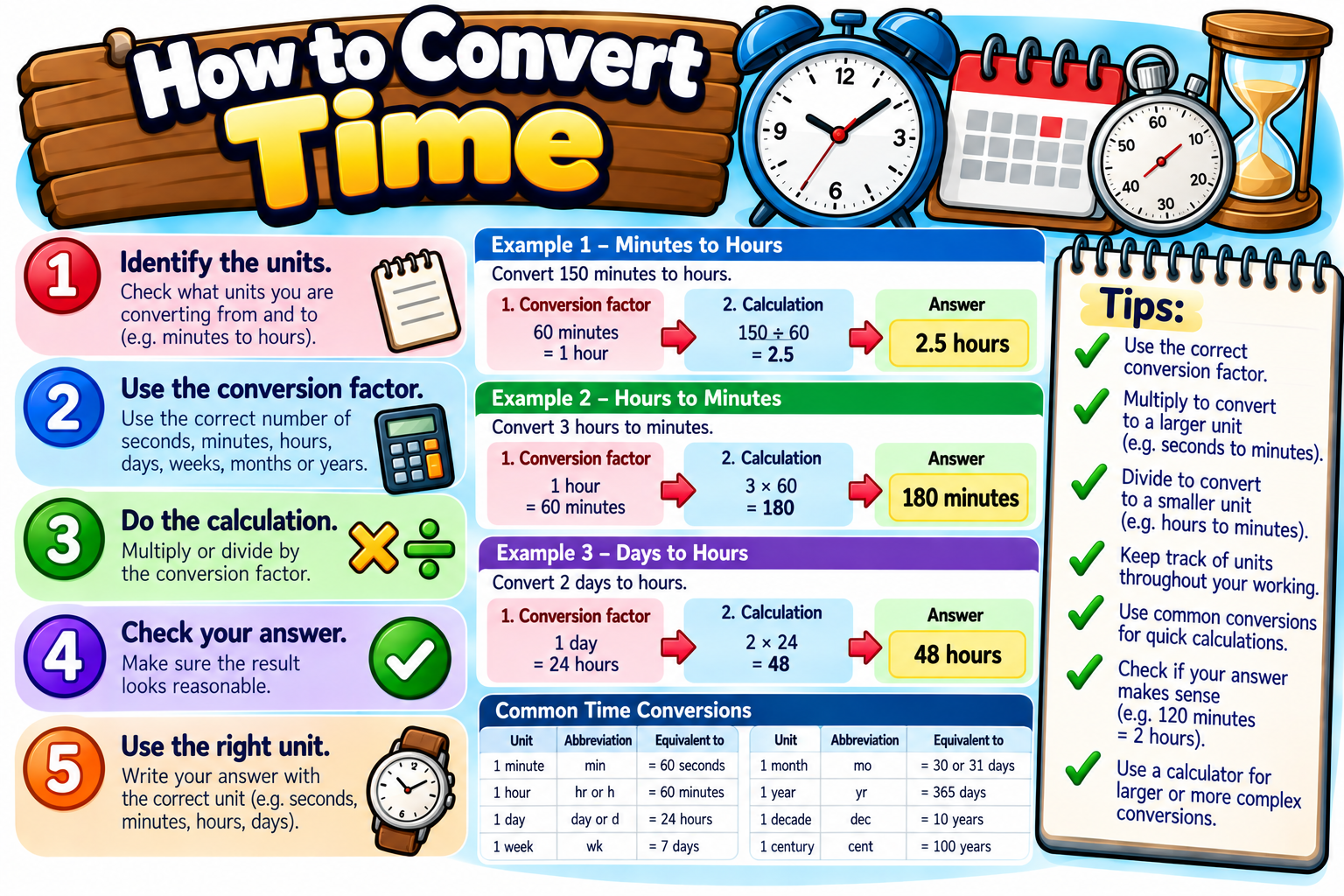
How to Do It
- Identify the starting and target units.
- Use 60 between seconds and minutes or minutes and hours.
- Use 24 between hours and days.
- Continue through additional units if needed.
- Check the final value and unit.
Worked Example
Convert 2.5 hours to minutes. 2.5 × 60 = 150 minutes.
Useful Tips
- Work one unit step at a time for complex conversions.
- Remember that decimal hours are not written like hours and minutes.
- Use calendar dates for exact month or year spans.
Common Mistakes
- Treating 1.5 hours as 1 hour 50 minutes instead of 1 hour 30 minutes.
- Using base 100 instead of base 60.
- Assuming every month has the same number of days.
Important Notes
Conversion factors and measurement standards can vary by country or context. When accuracy matters, confirm the standard being used and keep enough decimal places until the final answer.
FAQ
When should I round the answer?
Keep the full value during the calculation and round at the end to a level of precision suitable for the task.
Why should I always write the units?
The unit tells you what the number represents and helps reveal mistakes when converting or calculating.