Overview
Good price comparison looks beyond the sticker price and compares equivalent quantities, features and total costs.
Objective
Work out which option offers better value for your needs using a fair like-for-like comparison.
What You Need
- Prices of the options
- Quantities or sizes
- Any relevant fees, discounts or features
- Calculator
Before You Start
Decide what 'better value' means for the purchase: lowest unit cost, lowest total cost, better durability, more useful features, or another measurable factor.
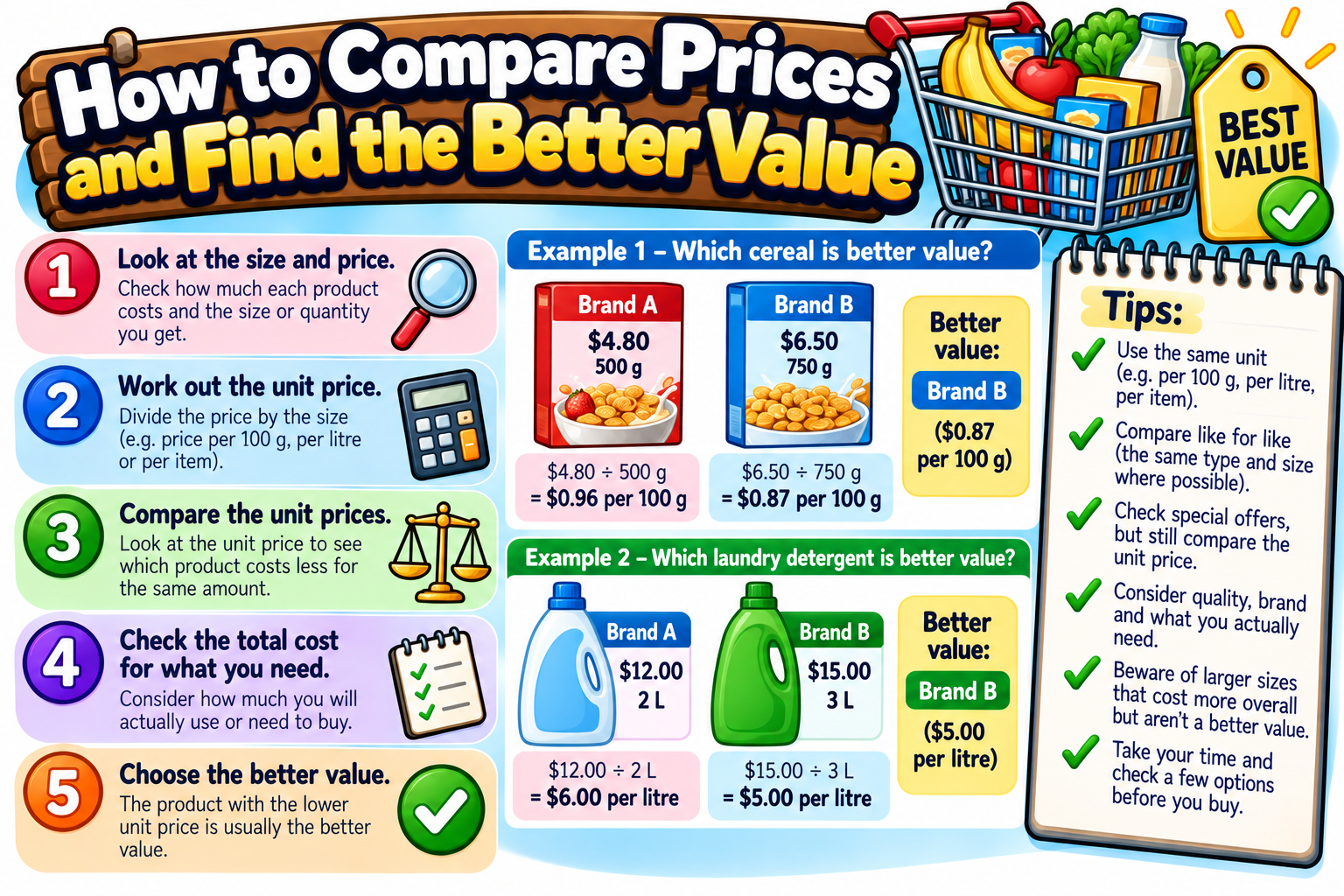
How to Calculate
- Put both options on the same basis, such as cost per kilogram or cost per use.
- Include relevant discounts, delivery charges or mandatory fees.
- Compare quality or useful features where they materially differ.
- Calculate the difference in dollars and, if useful, percentage terms.
- Choose the option that best matches the required value measure.
Worked Example
Pack A costs $8 for 1 kg. Pack B costs $6.60 for 750 g. A costs $8/kg; B costs $8.80/kg. Pack A has the lower unit price even though its shelf price is higher.
Useful Tips
- Compare unit prices before assuming the smaller package is cheaper.
- Only include features you will actually use.
- Consider waste: a bulk pack is not better value if much of it will be thrown away.
Common Mistakes
- Comparing sticker prices only.
- Ignoring different package sizes.
- Treating a larger discount percentage as proof of a lower final price.
- Ignoring compulsory fees.
Important Notes
For long-term purchases, value comparisons may include running costs, maintenance, expected lifespan and resale value as well as purchase price.
FAQ
Is cheapest always best value?
No. Value depends on what you receive and what matters for the purchase.
How can I compare different package sizes?
Convert both to the same unit price first.