Overview
Unit price shows the cost for one standard unit, making differently sized products easier to compare.
Objective
Calculate cost per item, kilogram, litre, metre or another common unit.
What You Need
- Product price
- Quantity or package size
- Calculator if needed
Before You Start
Convert package quantities to the same unit before comparing products.
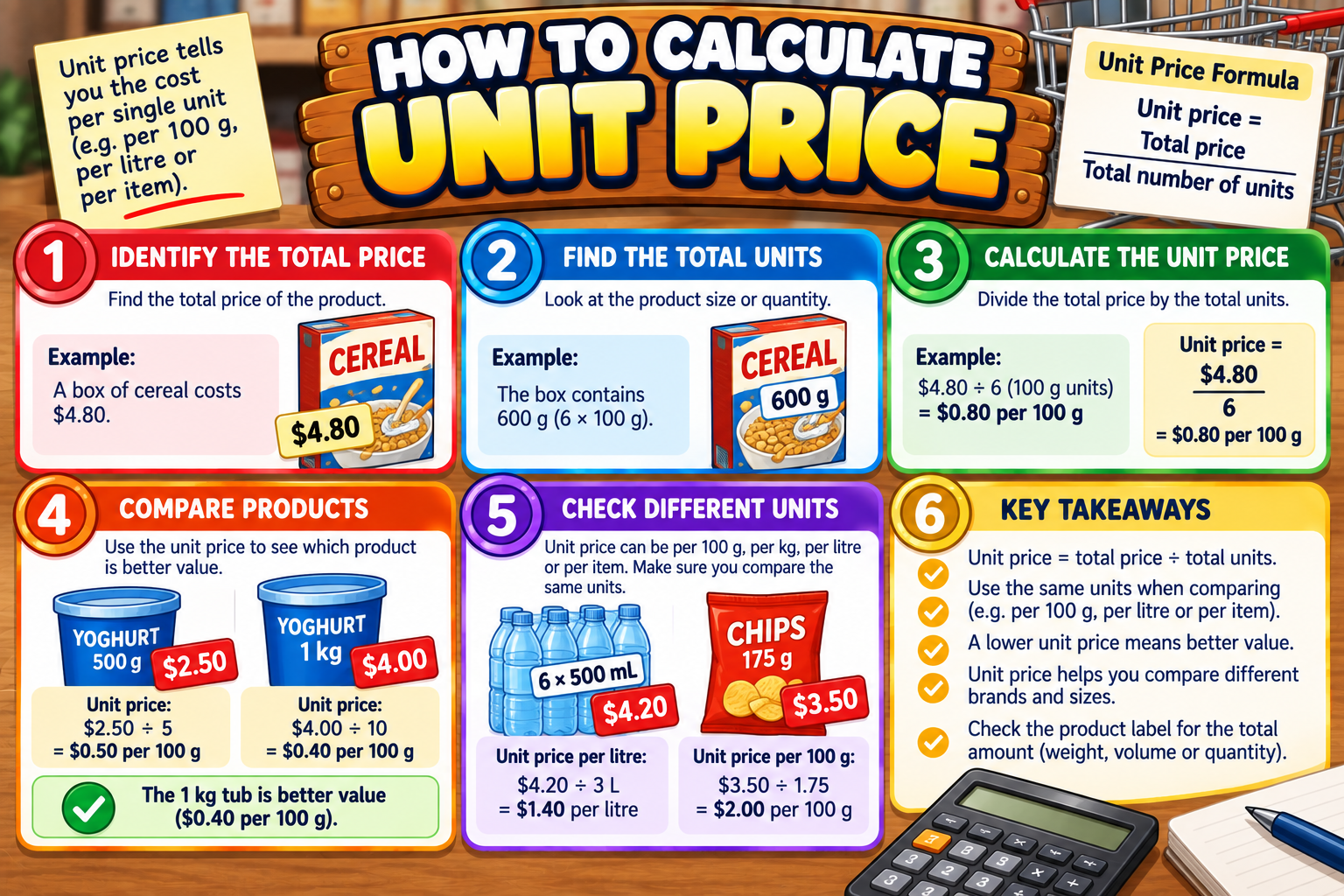
How to Calculate
- Unit price = total price ÷ quantity.
- State the unit clearly, such as $/kg or cents/100 g.
- Repeat for each product using the same unit.
- The lower unit price is cheaper per unit, although other factors may still matter.
Worked Example
A 750 g product costs $6.00. Cost per 100 g = 6 ÷ 7.5 = $0.80, or 80 cents per 100 g.
Useful Tips
- Use a convenient common unit such as per 100 g for small packages.
- Check whether the shelf label already gives a reliable unit price.
- Compare equivalent quantities and product types.
Common Mistakes
- Comparing package prices without considering size.
- Using kilograms for one product and grams for another.
- Forgetting that promotions can change the effective price.
Important Notes
Unit pricing can also be used for multipacks, fuel, electricity, printing, materials and other purchases.
FAQ
Is the lowest unit price always the best choice?
Not necessarily; quality, waste, storage and how much you actually need also matter.
How do I compare a multipack?
Divide the total pack price by the number of items, or by the total weight/volume if that is more useful.