Overview
Savings growth can come from the starting balance, regular contributions and interest earned over time.
Objective
Estimate how savings may grow under stated contribution and interest assumptions.
What You Need
- Starting balance
- Regular contribution
- Interest rate
- Time period
- Compounding frequency
Before You Start
Separate the starting lump sum from future regular deposits. Decide whether contributions occur at the beginning or end of each period if precision matters.
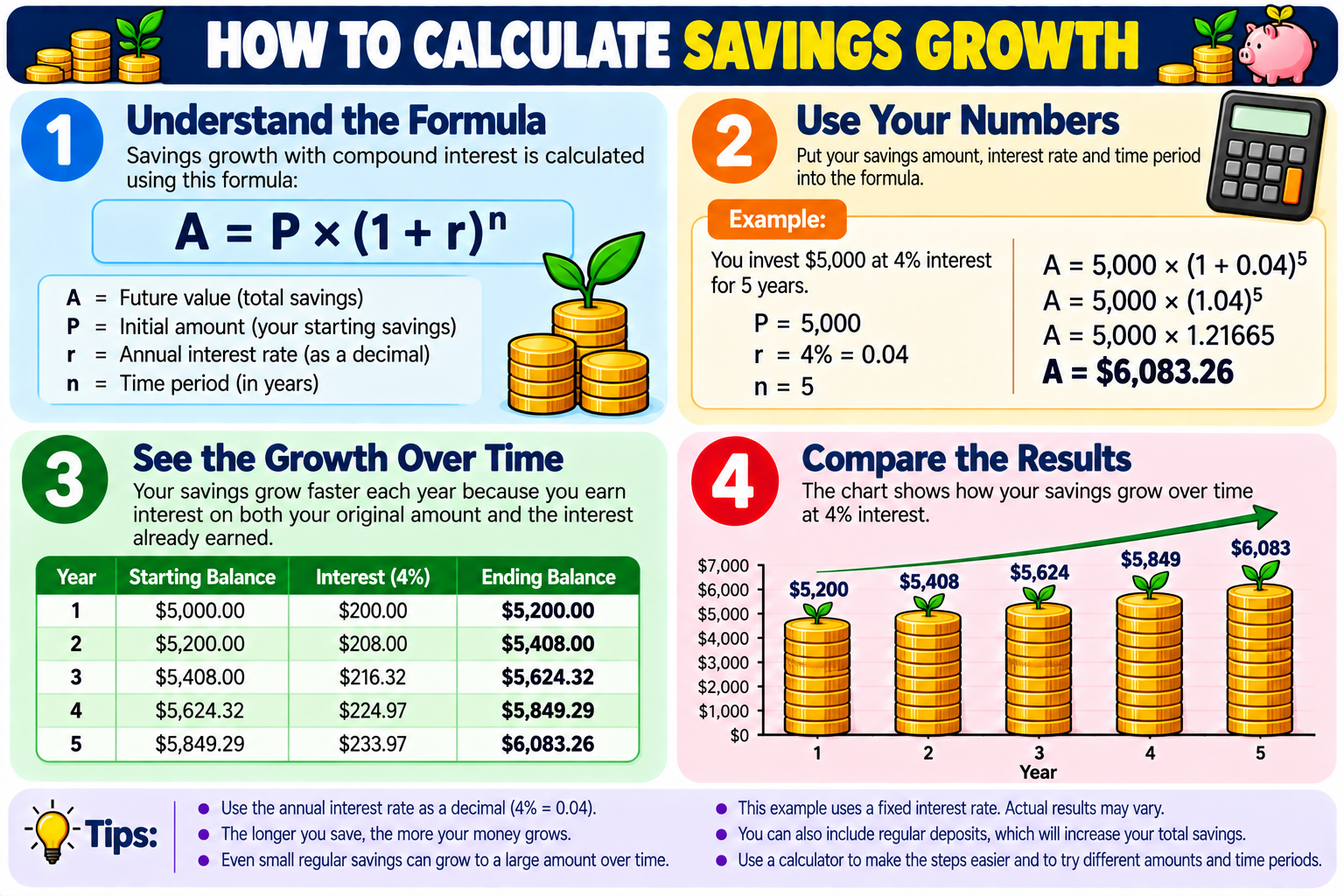
How to Calculate
- Calculate growth of the starting balance using compound interest.
- Calculate the future value of regular contributions using the matching periodic rate.
- Add the two future values.
- Compare the result with total contributions to see how much growth came from interest.
Worked Example
If you save $100 each month, your contributions alone total $1,200 after 12 months. Any interest earned is added on top, with the exact amount depending on rate, timing and compounding.
Useful Tips
- Consistency of contributions often matters more than small short-term rate differences.
- Use the same time unit for contributions and compounding.
- Test several rates rather than assuming one rate will remain unchanged for years.
Common Mistakes
- Applying a lump-sum compound formula to all future deposits as though they were invested from day one.
- Ignoring contribution timing.
- Assuming an advertised rate will remain constant indefinitely.
Important Notes
Savings accounts, term deposits and investment products can use different rates, fees and tax treatment. Growth projections are estimates, not guarantees.
FAQ
Why do regular deposits earn different amounts of interest?
Each deposit is invested for a different length of time.
Is savings growth guaranteed?
Only according to the actual product terms; future rates and investment returns may change.