Overview
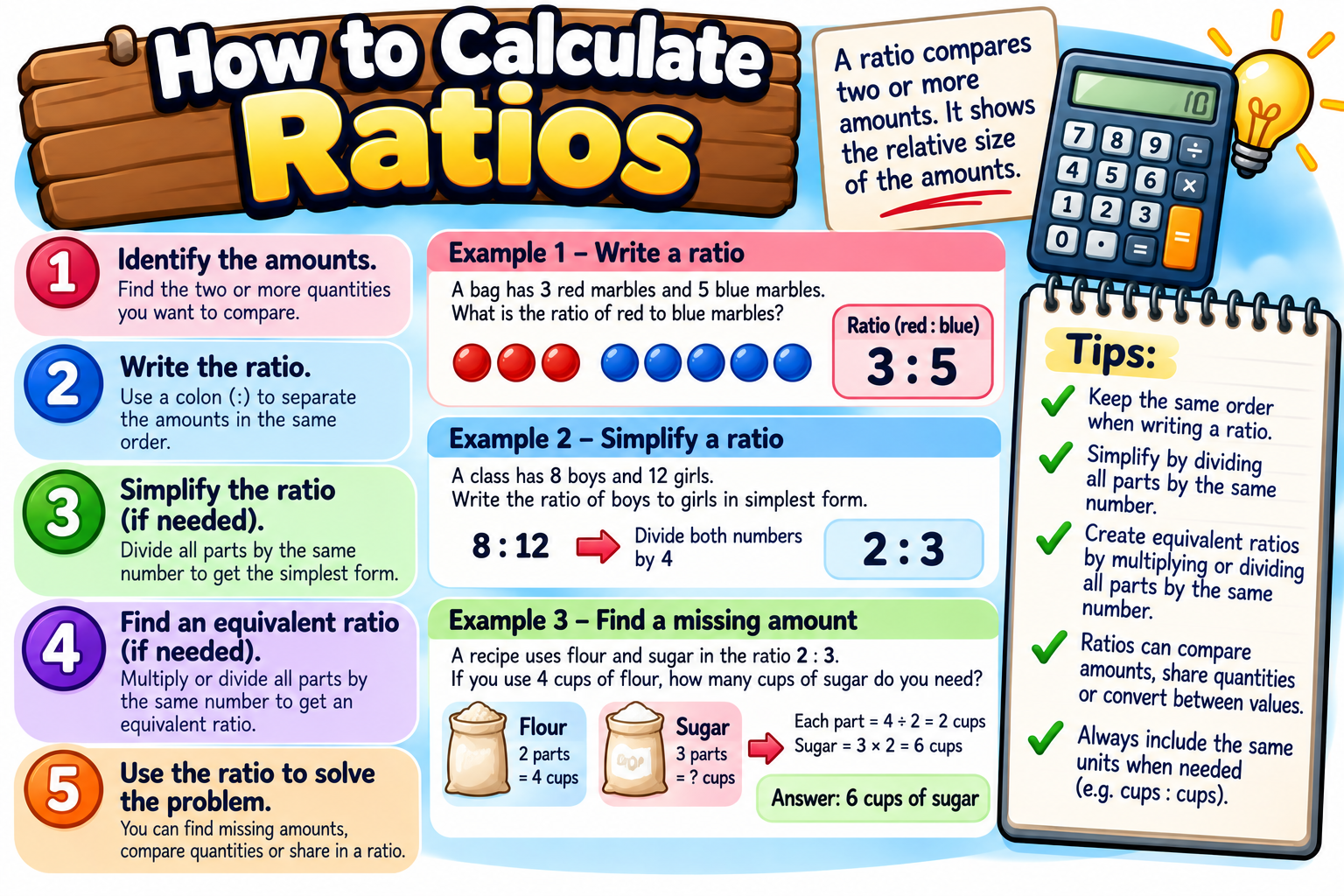
A ratio compares two or more quantities and shows their relative sizes.
Objective
Write, simplify and use ratios to compare or divide quantities.
What You Need
- The quantities being compared
- Calculator or paper if needed
Before You Start
Make sure the quantities use compatible units. Write them in the same order as the question, then simplify by dividing each part by a common factor.
How to Calculate
- Write the quantities as a ratio, such as 12:8.
- Find a common factor.
- Divide every part by the same factor.
- For sharing in a ratio, add the ratio parts, find the value of one part, then multiply.
Worked Example
The ratio 12:8 simplifies by dividing both numbers by 4, giving 3:2. To share $100 in a 3:2 ratio, there are 5 parts, so each part is $20: the shares are $60 and $40.
Useful Tips
- Keep the order of quantities consistent.
- Convert units before forming the ratio.
- For ratio sharing, check that the final shares add back to the total.
Common Mistakes
- Reversing the order of the ratio.
- Dividing only one side when simplifying.
- Comparing quantities expressed in different units without converting them.
Important Notes
Ratios may be written as 3:2, 3 to 2, or as a fraction depending on context.
FAQ
Does a ratio have units?
When comparing like quantities, the simplified ratio is usually unitless.
Can a ratio have more than two parts?
Yes, such as 2:3:5.