Overview
Profit occurs when income or selling price exceeds cost; a loss occurs when cost exceeds income or selling price.
Objective
Calculate the dollar amount of profit or loss from revenue and costs.
What You Need
- Revenue or selling price
- Relevant costs
- Calculator or spreadsheet
Before You Start
Make sure revenue and costs cover the same transaction or period.
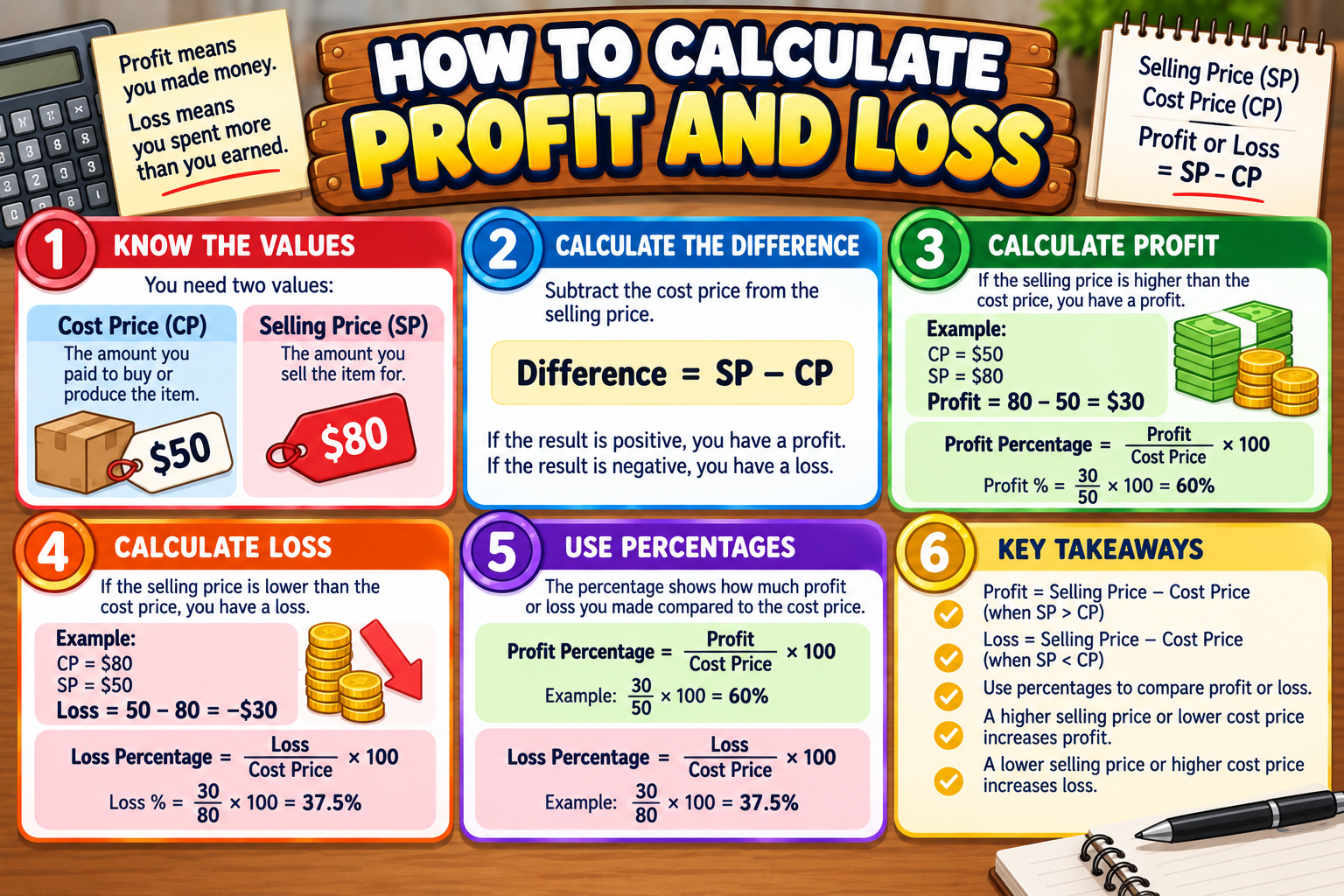
How to Calculate
- Profit/loss = revenue − costs.
- A positive result is profit.
- A negative result is a loss; its size is the absolute value of the negative result.
- For a business period, include all relevant costs specified by the calculation.
Worked Example
If an item sells for $150 and costs $110, profit = $150 − $110 = $40.
Useful Tips
- Separate revenue from costs before calculating.
- Be clear whether cost means purchase cost only or all associated expenses.
- Do not confuse profit amount with profit margin.
Common Mistakes
- Leaving out relevant costs.
- Subtracting revenue from cost and mislabelling the sign.
- Calling a $40 profit a 40% margin without calculating the percentage.
Important Notes
Gross profit, operating profit and net profit include different categories of costs. Use the definition required for the task.
FAQ
What is the simplest profit formula?
Profit = revenue − cost.
Is profit the same as cash in the bank?
No. Accounting profit and cash flow measure different things.