Overview
Percentage change measures how much a value has risen or fallen relative to its original value.
Objective
Calculate the percentage increase or decrease between an original value and a new value.
What You Need
- Original value
- New value
- Calculator or paper
Before You Start
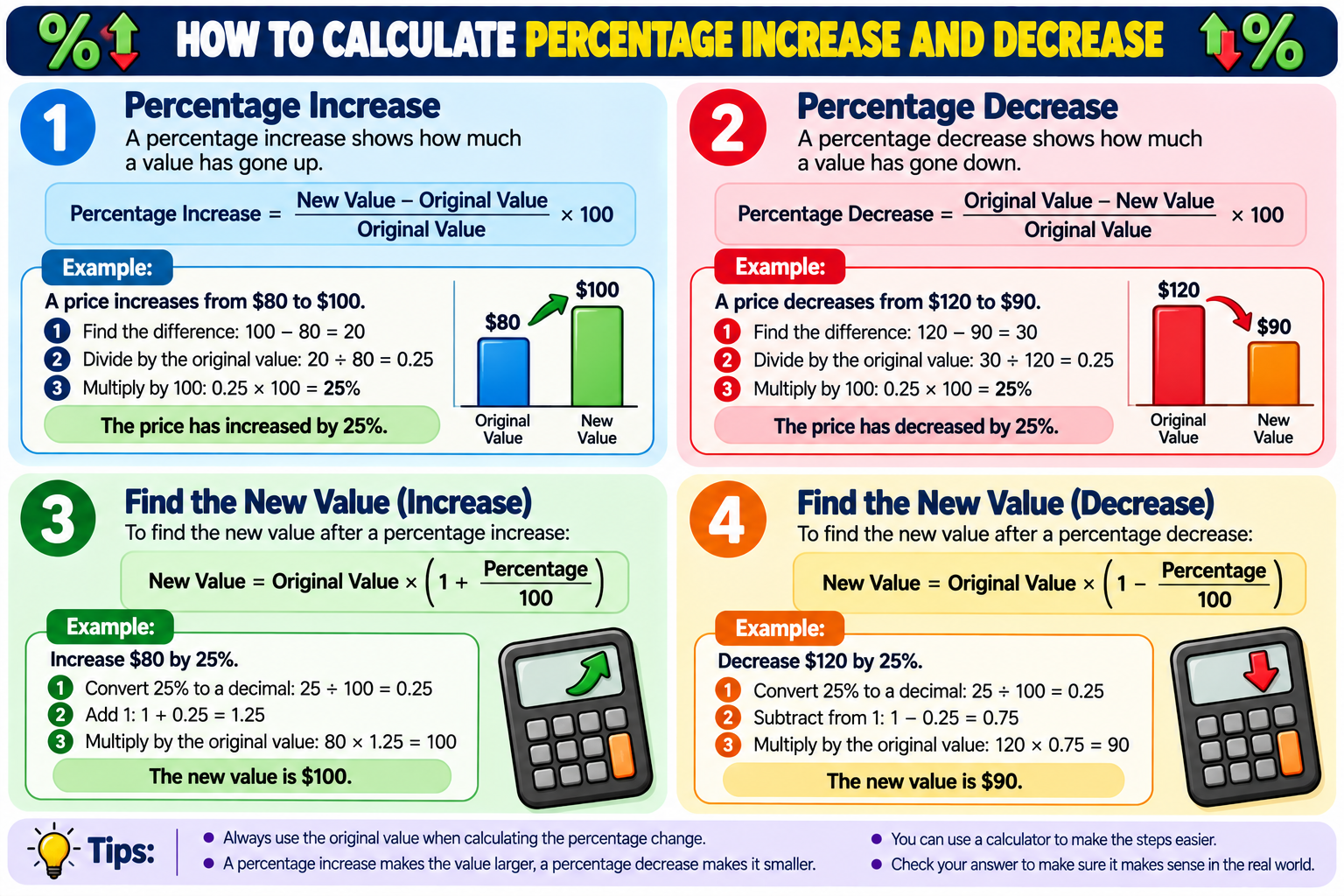
Find the difference between the new and original values, then compare that difference with the original value.
How to Calculate
- Find the change: new value − original value.
- For a decrease, use the size of the decrease as a positive change amount.
- Divide the change by the original value.
- Multiply by 100 to convert to a percentage.
- Label the result as an increase or decrease.
Worked Example
A price rises from $80 to $100. The increase is $20. 20 ÷ 80 × 100 = 25%, so the price increased by 25%.
Useful Tips
- Always divide by the original value, not the new value.
- Calculate the dollar or unit change first.
- A quick estimate can help confirm the result.
Common Mistakes
- Dividing by the new value.
- Using the difference without converting it to a percentage.
- Confusing percentage change with percentage points.
Important Notes
Successive percentage changes do not simply cancel. A 20% rise followed by a 20% fall does not return to the starting value because the second change uses a different base.
FAQ
What is the basic formula?
Percentage change = change ÷ original value × 100.
Why don’t equal percentage increases and decreases cancel?
Because each percentage is applied to a different starting amount.