Overview
Compound interest is calculated on the principal plus interest accumulated from earlier compounding periods.
Objective
Estimate or calculate how an amount grows when interest is compounded.
What You Need
- Starting principal
- Interest rate
- Time
- Compounding frequency
- Calculator
Before You Start
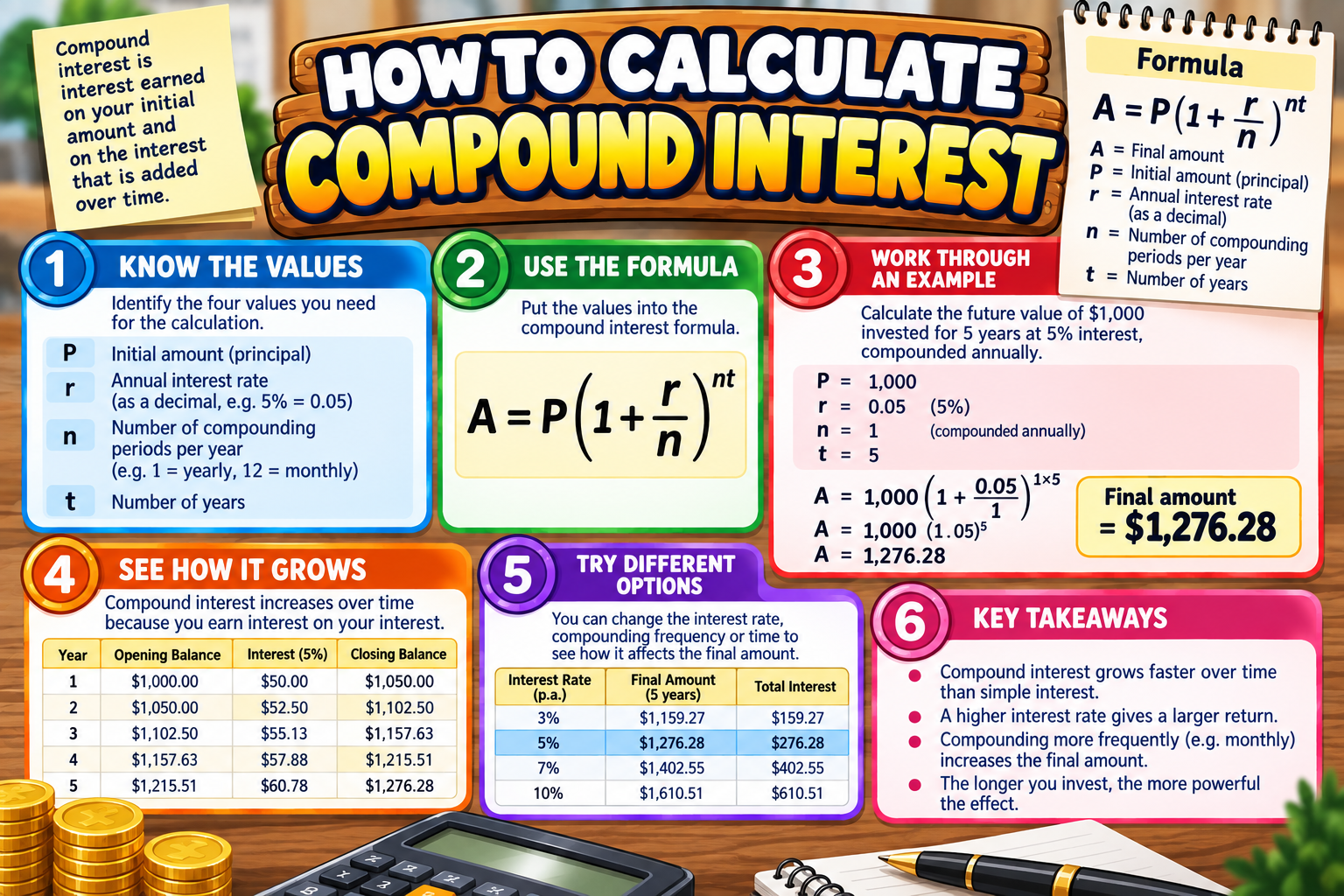
Identify the annual rate, number of compounding periods per year and total time. Convert the percentage rate to a decimal.
How to Calculate
- Use A = P(1 + r/n)^(nt).
- P is principal, r is annual rate, n is compounding periods per year and t is years.
- Subtract P from A if you need the interest earned rather than the final balance.
Worked Example
For $1,000 at 5% compounded annually for 2 years: 1000 × 1.05² = $1,102.50. Interest earned is $102.50.
Useful Tips
- Do not round intermediate values too early.
- Check whether interest compounds annually, monthly or at another frequency.
- For regular deposits, a savings-growth calculation is different from a single lump sum.
Common Mistakes
- Using the simple-interest formula.
- Ignoring compounding frequency.
- Confusing the final balance with the interest earned.
Important Notes
Financial products can use different compounding and fee conventions. Real-world results should use the terms supplied by the provider.
FAQ
Why is compound interest larger than simple interest?
Because later interest is also calculated on earlier interest.
Does more frequent compounding matter?
Yes, when the quoted rate and other conditions are the same, more frequent compounding generally produces a slightly different effective return.