Overview
A discount reduces an original price by a stated percentage or fixed amount.
Objective
Calculate the discount amount and the final sale price.
What You Need
- Original price
- Discount percentage or amount
- Calculator if needed
Before You Start
Identify whether the discount is a percentage or a fixed dollar amount.
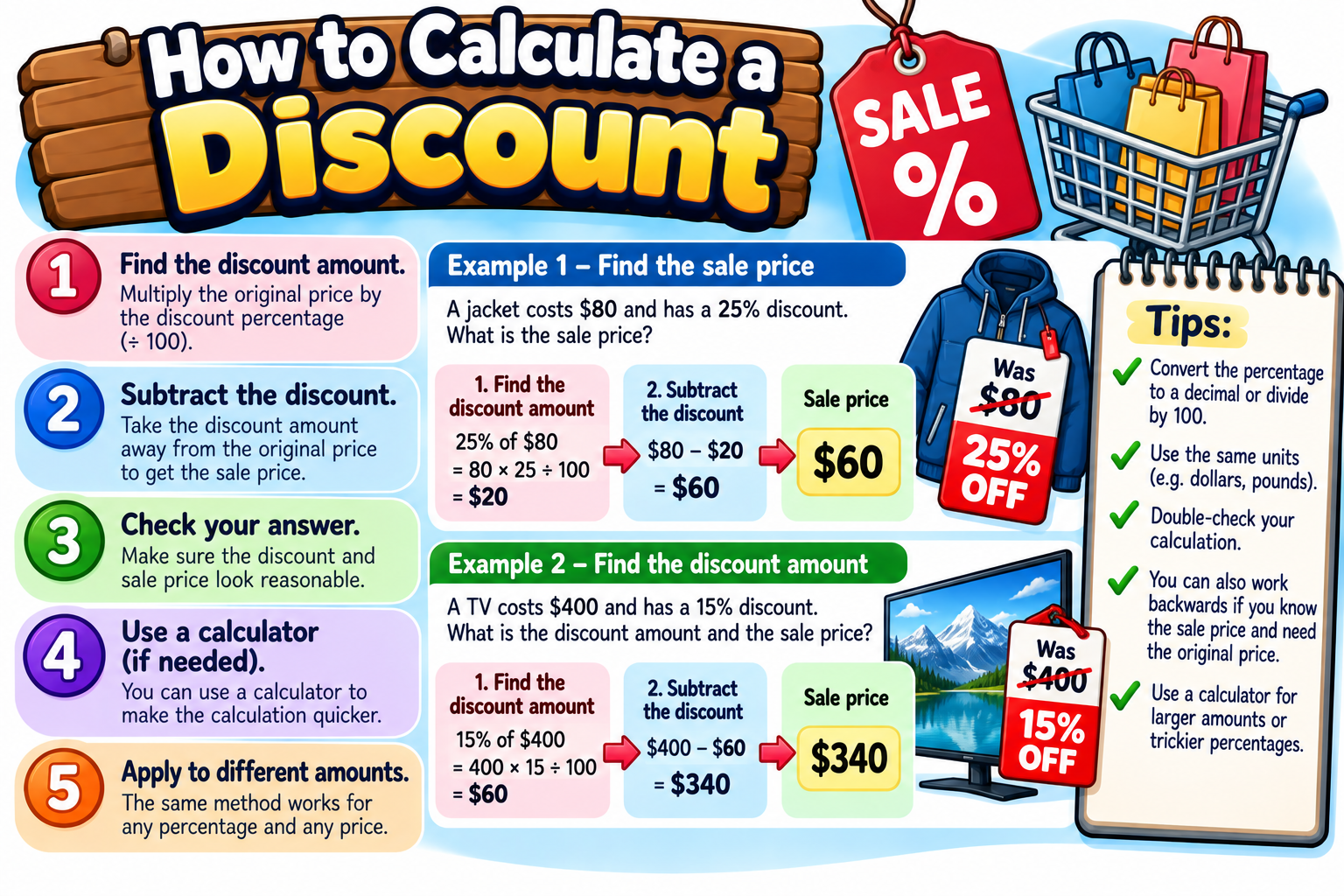
How to Calculate
- For a percentage discount, calculate original price × discount rate.
- Subtract the discount amount from the original price.
- Alternatively multiply the original price by the percentage remaining after the discount.
Worked Example
A $120 item with 25% off has a discount of $30. $120 − $30 = $90 sale price.
Useful Tips
- For 20% off, you pay 80% of the original price.
- Estimate the discount mentally before using a calculator.
- Keep discount amount and final price separate.
Common Mistakes
- Subtracting 25 dollars when the offer is 25%.
- Adding the discount instead of subtracting it.
- Applying multiple discounts as if their percentages simply add.
Important Notes
For successive discounts, apply each discount to the price remaining after the previous discount unless the offer states otherwise.
FAQ
Is 20% off the same as paying 80%?
Yes.
Do two 10% discounts equal 20% off?
Not exactly when applied one after another; the second 10% is calculated on the already reduced price.